Showing posts with label Business. Show all posts

Rake shuns Barclays chairman role: sources

Sunday, July 22, 2012 · Posted in

Rake shuns Barclays chairman role: sources
LONDON (Reuters) - Michael Rake, deputy chairman of Barclays Plc (BARC.L), has ruled himself out of contention to be its new chairman, striking a blow to the UK bank as it hunts for new leadership to steer it through its interest rate-rigging scandal.

Rake, who was considered favorite for the job, is not interested in the role, three people familiar with the matter said on Sunday.

The next Barclays chairman faces a stiff challenge. The bank was fined $450 million three weeks ago for manipulating Libor interest rates, and the scandal has unearthed deep problems in its relations with regulators, who have accused the bank of frequently being too aggressive.

The job will also attract intense scrutiny -- and possibly interference -- from UK authorities, who have been criticized for not doing more earlier to rein the bank in.

Rake would have been forced to give up his chairmanship roles at telecoms firm BT Group (BT) and budget airline easyJet (EZJ.L) to take the job.

He could not immediately be reached for comment.

Marcus Agius, chairman for 5-1/2 years, will step down once a replacement is found.

Barclays is also searching for a chief executive. Bob Diamond, who was CEO from the start of 2011, quit with immediate effect a week after the Libor settlement, following a political and public backlash. When he left, Agius took on the top executive responsibilities.

The fallout from the scandal is expected to overshadow the bank's half-year results on Friday, which should show it made an underlying profit of 3.8 billion pounds ($5.94 billion), according to the average of analysts polled by the bank.

Rich Ricci, head of Barclays' investment banks, is not interested in being chief executive, a person familiar with him said. He was not seen as a likely replacement for Diamond anyway, as he had been his key lieutenant for many years.

Barclays is expected to look for external candidates to fill both roles.

Headhunter Spencer Stuart is helping Agius in the search for a CEO and Ana Mann's MW is helping John Sunderland, a non-executive director at the bank, run the chairman search.

CEO candidates include former Barclays finance director and a current advisor Naguib Kheraj; Antony Jenkins, head of its retail business; and Bill Winters, former co-head of J.P.Morgan's (JPM) investment bank.

Candidates for chairman include former top civil servant Gus O'Donnell and Glen Moreno, the former Lloyds Banking Group (LLOY.L) deputy chairman who runs Pearson, the Sunday Times reported.

Anthony Sal, a veteran city lawyer, is expected to be picked this week to lead an investigation into the Libor scandal that the bank has pledged to conduct as it seeks to rebuild its reputation.

(Reporting by Steve Slater, Kate Holton and Rhys Jones; Editing by Mike Nesbit)
Read More >>

Green fleet upstarts make conventional Washington moves

· Posted in

Green fleet upstarts make conventional Washington moves

WASHINGTON (Reuters) - Two companies involved on the ground level of an expensive Pentagon effort to embrace biofuels have used familiar strategies in building their profiles in Washington, using hefty campaign contributions and aggressive lobbying to secure support.

One company, Solazyme Inc, a subcontractor on a $12 million alternative fuels contract from the Navy, also has raised its Washington profile by hiring as strategic advisers former senior Clinton administration officials with close ties to the Pentagon or Department of Energy, according to corporate records.

Solazyme and Gevo Inc, a Colorado company that won a small Air Force biofuels contract, are on the cutting edge of a $510 million Pentagon effort to switch to biofuels to curb reliance on foreign oil. But the high per-gallon cost of the biofuels has spurred controversy on Capitol Hill, where some Republicans have branded the program as wasteful and raised questions about political ties.

The Navy is paying $26 a gallon for the fuel it is using to test its "green fleet" concept. The prime contractor is Dynamic Fuels, a Louisiana-based company that is a joint venture of Arkansas-based Tyson Foods and Oklahoma-based Syntroleum Corp. Solazyme, which makes its biofuel from algae, is a subcontractor. Dynamic Fuels makes some of it fuel from animal fats.

The Air Force is paying Gevo $59 per gallon. Gevo makes its fuel by converting sugar into isobutanol.

Proponents of the program - as well as the Pentagon - argue that costs per gallon will dramatically drop after production ramps up and will eventually be competitive with fossil fuels.

Even as the biofuel companies work to build revenues in an emerging field, their investors and employees have worked the political system, campaign finance records show. Investors, officers and employees at Solazyme and Gevo have contributed hundreds of thousands of dollars to political campaigns in recent years, primarily to Democrats.

Both companies have relied on extensive lobbying to help them win modest contracts.

Solazyme relies on in-house lobbyist Drew Littman, a former staffer to Democratic Senators Al Franken of Minnesota and Barbara Boxer of California. This year, it also hired McBee Strategic Consulting L.L.C., which represented Solyndra, the solar panel maker that went bankrupt after receiving more than $500 million in federal loans.

Solazyme also solicits strategic advice from two prominent Clinton administration officials - former CIA director R. James Woolsey, who has served in other administrations as well, and former Deputy Energy Secretary T.J. Glauthier.

Glauthier also served for five years in the Clinton White House at the Office of Management and Budget. He was on President Barack Obama's transition staff and worked on the energy portion of the stimulus bill.

"I had no contact with any agencies or others in the administration about Solazyme's bids or contracts for biofuels," Glauthier told Reuters.

Jonathan Wolfson, chief executive officer of Solazyme, said the company needs a strong Washington presence to counter the entrenched interests of rivals, including the oil industry. Shareholders of the publicly traded company deserve to know about legislative and administrative developments in Washington that might affect biofuels, Wolfson said.

Biofuels lobbying pales in comparison to the lobbying budgets of the oil and gas industries, he said.

Wolfson said campaign contributions by people associated with Solazyme had nothing to do with the company's Washington agenda. Most came from one person - board chairman Jerry Fiddler, who has given $358,000, mostly to Democrats. Fiddler, long active in Democratic politics, made his fortune selling his software company to Intel.

"Jerry's political donations are Jerry's private, personal business," said Wolfson. "I can absolutely guarantee you there are not discussions with management or with the board about what Jerry does with respect to his political donations. The fact that Jerry donated a lot of money is accurate. The fact that T.J. (Glauthier) had a relationship in DoE (Department of Energy) is accurate. But people are drawing lines to things that are not reality."

Fiddler could not be reached for comment.

Gevo spent $360,000 over three years for the services of Green Capitol LLC, according to lobbying records. The principals of the firm are a former Capitol Hill aide who worked on energy programs and a former official of the Air Transport Association, the major airlines' trade organization, who pushed the Air Force to experiment with biofuels.

Gevo's Air Force contract was worth $639,000.

A key Gevo investor is venture capitalist Vinod Khosla, who co-founded Sun Microsystems and has given $474,000 in campaign contributions since 1996, mostly to Democrats, according to a Reuters' compilation of campaign finance data on opensecrets.org.

Khosla told Reuters through a spokesman that he had no knowledge of the Air Force contract and declined further comment.

Of the companies helping provide biofuels to the Navy and Air Force, Tyson Foods has by far the highest profile in Washington.

Its political action committee has given $1.9 million in contributions since 1990 to candidates of both parties. Its president, John Tyson, has made $225,000 in contributions to both parties in the past six years. The company has spent $10.7 million on lobbying in the past five years, according to opensecrets.org.

Formed in 2005, Gevo seeks to retrofit ethanol plants to make isobutanol, which is more powerful and less damaging than ethanol to the machines that burn it, including cars. Gevo reported revenues of $64 million in 2011.

Solazyme, founded in 2004, creates oil from microalgae grown in fermentation tanks. Solazyme reported $39 million in revenues in 2011.

(Reporting by Marcus Stern; Editing by Marilyn W. Thompson; Desking by Vicki Allen)
Read More >>

Rupert Murdoch quits boards of British papers

· Posted in

Rupert Murdoch quits boards of British papers
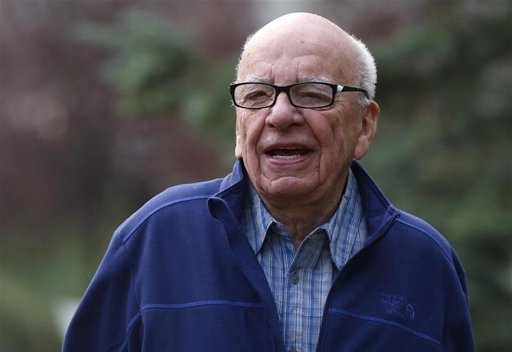
LONDON - News Corp's Rupert Murdoch has stepped down from a string of boards overseeing the Sun, Times and Sunday Times newspapers in Britain, the company said in an internal memo on Saturday.

The company described the news as a "corporate housecleaning exercise" linked to the announcement in June that News Corp would split into two separate companies: a smaller publishing division and a much larger entertainment and TV group.

But the news is also likely to reignite speculation that News Corp could be preparing to sell the titles, following a phone hacking scandal at the now defunct mass-circulation News of the World that has damaged Murdoch's reputation in Britain.

The revelations of sustained criminality prompted an influential parliamentary committee in May to describe Murdoch as unfit to run a major company.

James Murdoch, who was chairman of the British newspaper arm News International when the revelations emerged, has already quit the British newspapers and moved to the United States.

"Last week, Mr. Murdoch stepped down from a number of boards, many of them small subsidiary boards, both in the UK and U.S. This is nothing more than a corporate housecleaning exercise prior to the company split," a spokeswoman said.

As part of the plan, the $53 billion media conglomerate will be split into two publicly traded companies, with the Murdoch family retaining control of both.

"I wanted to let you know that Rupert Murdoch has resigned as director of a number of companies, including NI Group Limited, known to most of you as News International, and Times Newspapers Holdings Limited," Tom Mockridge, the head of News International, said in the email, seen by Reuters.

"As you may be aware, Rupert resigned from a number of UK boards, including News Group Newspapers and Times Newspapers Limited, some time ago. He has also stepped down from more than a dozen boards of companies with interests in the U.S., Australia and India."

Mockridge said Murdoch remained fully committed to the business as chairman of what would become the largest newspaper and digital publishing group in the world.

Speculation had risen in the last year that News Corp could seek to sell the British papers, following pressure from shareholders over a scandal that also forced the group to cancel its planned acquisition of the whole of the lucrative pay-TV group BSkyB, which would have been the biggest deal in News Corp's history.

The announcement in June to split the business was seen as a clear signal that the group was distancing itself from its newspaper roots.
Read More >>

Super rich hold $32 trillion in offshore havens

· Posted in

Super rich hold $32 trillion in offshore havens
Rich individuals and their families have as much as $32 trillion of hidden financial assets in offshore tax havens, representing up to $280 billion in lost income tax revenues, according to research published on Sunday.

The study estimating the extent of global private financial wealth held in offshore accounts - excluding non-financial assets such as real estate, gold, yachts and racehorses - puts the sum at between $21 and $32 trillion.

The research was carried out for pressure group Tax Justice Network, which campaigns against tax havens, by James Henry, former chief economist at consultants McKinsey & Co.

He used data from the World Bank, International Monetary Fund, United Nations and central banks.

The report also highlights the impact on the balance sheets of 139 developing countries of money held in tax havens by private elites, putting wealth beyond the reach of local tax authorities.

The research estimates that since the 1970s, the richest citizens of these 139 countries had amassed $7.3 to $9.3 trillion of "unrecorded offshore wealth" by 2010.

Private wealth held offshore represents "a huge black hole in the world economy," Henry said in a statement.

(Reporting by Chris Vellacott)
Read More >>

After Colorado Massacre, Reassessing Public Safety

· Posted in

After Colorado Massacre, Reassessing Public Safety
The massacre at the Century 16 Movie Theaters in Aurora, Colo., early this morning has business owners and patrons asking what more can be done to improve security at public gathering places.

“I don’t know if you could ever really avoid this,” said Geoffrey Kohl, conference director for secured cities, a national conference on urban cities. “If you could throw all the security measures at it, you could likely minimize it.” But there’s only so much that can be done.

“If you went through those drastic measures -pat downs and metal detectors – it would not be an enjoyable experience and you’d also be putting a cost on theaters that they may not have the profit to bear,” he added.

Cinemark, which owns the theater in Colorado, has 459 theaters in the United States and Latin America, according to its corporate page. The company is the third-largest chain in the U.S. with 298 theaters and 3,895 screens in 39 states.

Cinemark did not immediately return our request for comment on security measures. In a statement, the company said: “Cinemark is deeply saddened about this tragic incident. Our thoughts and prayers are with the victims, their families and loved ones, our employees, and the Aurora community. We are grateful for the quick and professional reaction of all local law enforcement and emergency responders. Cinemark is working closely with the Aurora Police Department and local law enforcement as more facts develop.”

Founded in 1984, the Plano, Texas-based chain operates under Century Theatres, CineArts, and Tinseltown.

Initial reports were that the Colorado gunman bought a ticket, went in and sat down with the crowd. About 30 minutes in, he exited the cinema to the parking lot though an emergency exit then returned through the same door heavily-armed and opened fire.

A spokesperson for National Association of Theatre Owners said, “”We are grateful for the quick and effective response by police and emergency personnel. Guest safety is, and will continue to be a priority for theater owners. NATO members are working closely with local law enforcement agencies and reviewing security procedures.”

Theaters in New York City and Washington, D.C. reported they are beefing up security for movies showings in the wake of the shootings. Police Commissioner Ray Kelly said in a statement that the decision was ”a precaution against copycats and to raise the comfort levels among movie patrons.”

Carlo Petrick, a spokesman for Marcus Theatres, which has 600 U.S. screens, told Time in a statement: ”These senseless, random acts of violence, by disturbed individuals, can happen anywhere, but have never occurred in a U.S. movie theater in its 110-year history. Safety and security of our guests and associates is always a priority concern. We will take appropriate measures to have our security precautions in place today and every day. All showings of ‘Dark Knight’ and all other motion pictures at all Marcus Theaters will go on as scheduled.”

The Colorado theater is the just latest business impacted by violence on patrons.

About 11 days ago, a gunman wounded five people after opening fire in the parking lot of Oakland’s Jack London Square at the Regal Cinemas in California. Since the shooting, its business as usual at the multiplex, with “The Dark Knight Rises” expected to play at 11:40 a.m., according to Fandango.

In Seattle, a gunman opened fired at Cafe Racer Expresso in Seattle, killing five people two months ago. While the doors of the Cafe closed for seven weeks, an unnamed worker told ABC News today, “our community rebuilt the cafe.” While the doors were shuttered, numerous fundraising efforts were held to to help the victims of the shooting, including Cafe Racer Lover.

Kohl says theater and concert venue owners need to step up their vigilance. ”I think you have to have your staff start to identify people coming in. Maybe when you’re trying to identify people bringing in extra food, you’re scanning your customers as they come in to keep them from bringing that [weapons] in. Is there a bulk on this person that might be concealing? You have to start with your employees. Bringing them into a security awareness,” said Kohl.

Staff must be trained to react in case there’s a threat. “Questions you should ask if there is danger: Do you evacuate? Do you shelter in place. Do you turn the lights on? Do you dim the lights? What do you do with your staff? Your staff are trained in collecting tickets, making popcorn but they’re not trained as security. How do you train them in assisting guests? Bring in a professional security consultant and start to consider those,” Kohl advised.

But, ultimately violent acts by people intent on doing as much damage as they can and with easy access to firearms is unavoidable.

“This is a rare occurrence and I’d like to think this would stay a rare occurrence,” said Kohl.
Read More >>

Telcos get into annual Ramadhan rat race

· Posted in

Telcos get into annual Ramadhan rat race
Competition is heating up among telecommunication operators in Indonesia, as each firm eyes higher profits and new customers by launching ambitious Ramadhan and Idul Fitri holiday packages. However, with an already saturated market, the competition might just become unhealthy, an expert said.

This year, celebrating Ramadhan and Idul Fitri, PT XL Axiata introduced a special offer called “Xensasi Ramadan” (Ramadhan Sensation). It offers affordable calls, with some free perks to its prepaid and postpaid customers. Customers will also be able to enjoy Islamic-themed mobile content and services aimed at Idul Fitri holiday travelers.

XL did not set up a specific target for new customers, but had prepared 4 million new cards under the Xensasi Ramadhan program, XL spokesman Henry Wijayanto said on Friday. “We hope the new customers will continue using our products after Idul Fitri,” he said.

Indonesia’s second-largest telecommunication operator, PT Indosat, recently launched the “Ramadhan Makin Penuh Berkah” (Ramadhan Full of Bliss) campaign, which boasts a variety of free services and Islamic-themed content. As part of the program, “Gratis 3 Hari 3 Malam ++”, enables Indosat’s prepaid customers to make phone calls, send text messages and use internet services for free for three consecutive days just by reloading their cards.

Indosat product development and management group head Sumantri Joko Yuwono said the company had upgraded its capacity to handle expected surges. “Now we can handle 924 million minutes of voice calls and 1.4 billion text messages per day following the upgrades,” he said.

PT Telekomunikasi Seluler (Telkomsel), Indonesia’s biggest operator, also has its special Ramadhan programs in store. Some of the services offered include mobile sermons, Islamic ringtones and free Internet during sahur (the pre-dawn meal in Ramadhan).

Telecommunication operators have to present their best promotions to win this tight competition, PT Indosurya Asset Management analyst Reza Priambada said.

In March, the Indonesian Cellular Telecommunication Association (ATSI) said the country’s telecommunication industry had reached a saturation point, with penetration of SIM (Subscriber Identity Module) cards standing at 250 million numbers in a country of about 240 million people.

The 2011 data of TeleGeography, a US-based telecommunications market research and consulting firm, shows that Telkomsel dominated the Indonesian telecommunications market with 43 percent, followed by Indosat and XL Axiata with 21 and 19 percent respectively.

Reza said most operators expected a 5 to 10 percent increase in terms of new customers during Ramadhan, but it would be difficult because these companies were basically offering the same products and targeting the same market. “They really have to struggle to win this tight competition,” he said. This trend, he added, would repeat in the next holiday seasons. (tas)
Read More >>

4 ASEAN nations ready for economic integration

Friday, July 20, 2012 · Posted in

4 ASEAN nations ready for economic integration
Representatives from four ASEAN nations - Cambodia, Myanmar, Laos and Indonesia - vowed that rules and regulations are being improved to embrace an investment flow in light of the activation of the ASEAN Economic Community (AEC) in 2015.

At the Krungthep Turakij seminar on "AEC Plus: Your Business sto the New Frontier" yesterday, the representatives said that they welcome investment from neighboring countries should these benefit local workers and be friendly to the environment.

Ros Sao, Commercial Counselor, Royal Embassy of Cambodia, said at the seminar that his country is ready for the AEC, through a series of training courses to prepare its people for the integration. He said that the legal framework and infrastructure has been improved, and Cambodia stands ready to answer all questions from its neighbors.

Ade Veronica Christie, Third Secretary of the Embassy of the Republic of Indonesia in Bangkok, noted that her country is not 100 per cent ready for the integration, but Indonesia has done its best to ensure that investors and Indonesian people would gain equal benefits from greater investment.

Indonesia has amended the tax code, lowering levy on some types of investment to zero per cent. An online one-stop service centre is prepared to facilitate applications and reduce complication and fees.

The government has also identified areas for particular investment, like the Sumatras for energy resources and Java for industrial manufacturing.

Indonesia has abundant natural resources, but labor wage is lower than that of some countries in ASEAN. With the economic growth rate of 6 per cent per annum, Indonesia is in the position to draw more investment and that encourages the country to prepare for the integration, she added.
Read More >>

New iPad goes on sale in China after suit settled

· Posted in

New iPad goes on sale in China after suit settled
Apple released its newest iPad in China on Friday after settling a lawsuit over ownership of its name and requiring buyers to place orders in advance to control crowds.

Watched by security guards, a few dozen shoppers waited outside stores in Beijing and Shanghai, which opened on time at 8 a.m. That was in contrast to the chaotic scene outside Apple's main Beijing store in January, when some customers who wanted to buy a new iPhone shouted and threw eggs after managers delayed the opening due to safety concerns about the hundreds of people waiting.

Sun Xufei, a 32-year-old computer technician who was the first customer in line in Shanghai, said he had put off buying an iPad so Apple had time to develop "a perfect one." The 30 customers in line when the store opened were outnumbered by the reporters watching them.

"I am very surprised to see there is nobody here waiting," Sun said.

Apple Inc. cleared a potential legal hurdle to the release when it paid $60 million this month to settle a dispute with a local company, Shenzhen Proview Technology Ltd., over ownership of the iPad name. Apple said it bought global rights to the iPad name from Proview in 2009 but Chinese authorities say the rights in China were never transferred.

China is Apple's second-largest market after the United States and the source of much of the Cupertino, California-based company's sales growth.

Qu Hongyu, a 20-year-old university student in Shanghai, expressed frustration that Apple waited four months after the new iPad debuted abroad to release it in China.

Qu said she could have asked a friend abroad to send her one, "but I think it's better to get the product here, because I don't want to owe somebody a favor."
Read More >>

Asia stocks waver as data keeps sentiment in check

· Posted in

Asia stocks waver as data keeps sentiment in check
Asian stock markets wavered Friday as weak U.S. data kept sentiment in check despite continued hopes for new stimulus measures in major economies.

Investors have been anticipating further moves by China to prop up slowing economic growth and also have continued to believe the U.S. Federal Reserve will announce additional pro-growth measures despite Fed chairman Ben Bernanke giving no indication of that in his two-day testimony to lawmakers this week.

The mood of optimism in markets the past few days linked to stimulus hopes was tempered by a batch of weak economic U.S. data. Weekly jobless claims rose 34,000 to a three-week high of 386,000 and an indicator of regional manufacturing was much weaker than anticipated. Homes sales and leading economic indicators were also soft.

"The outlook ... is clouded by uncertainty surrounding the Chinese and US economies, in addition to lingering risk of a blowout in Europe," analysts at DBS Bank in Singapore said in a report. "Growth in China has been especially critical in driving growth in Asia, and even global growth."

Japan's Nikkei 225 was down 0.9 percent at 8,717.60 while Hong Kong's Hang Seng added 0.2 percent to 19,602.21.

Australia's S&P/ASX 200 was little changed at 4,206.10 and China's Shanghai Composite dropped 0.4 percent to 2,175.75.

Markets in Singapore, India and New Zealand were down while Thailand, Indonesia and the Philippines rose.

In the U.S. on Thursday, the Dow Jones industrial average rose 0.3 percent to 12,943.36 and the broader S&P 500 index gained 0.3 percent to 1,376.51 as strong corporate earnings buoyed investors.

Benchmark oil was down 53 cents at $92.13 a barrel in electronic trading on the New York Mercantile Exchange. The contract surged $2.79, about 3 percent, to $92.66 in New York on Thursday, its highest level since mid-May.

In currencies, the euro was down 0.1 percent to $1.2260. The dollar fell 0.2 percent to 78.62 yen.
Read More >>

Chinese premier says economic woes to continue

Sunday, July 15, 2012 · Posted in

Chinese premier says economic woes to continue

China's economic woes that have brought growth to a three-year low will continue for some time, but the slower expansion remains within expectations, Premier Wen Jiabao said Sunday.

Speaking during a tour of the southwestern city of Chengdu, Wen said Chinese need to recognize the seriousness and complexity of the challenges the country faces. But he added that China's economic fundamentals remain favorable.

"At present, our country's economic growth rate remains within the target range set earlier this year and we are seeing the effectiveness of stabilization policies," Wen said in remarks posted on the central government's official website.

The government will prioritize job creation and provide financial aid and tax breaks to companies suffering from slowing exports due to sinking overseas demand, Wen said. Private investment will be encouraged and the government will promote industrial upgrading and urbanization to spur consumption, he said.

"All regions and departments need to proceed with even greater determination and courage," Wen said.

His comments follow the government's announcement Friday that the world's second-largest economy grew by 7.6 percent in the three months ending in June over a year earlier. That was the lowest since the first quarter of 2009 during the depths of the global financial crisis.

Growth was down from the previous quarter's 8.1 percent, damping hopes that China can make up for US and European weakness, but in line with the government's official target of 7.5 percent for the year

Private-sector forecasters say the economy may have bottomed out during the first two quarters and China still is likely to achieve its target for the year.

Export growth has fallen and consumer spending weakened despite stimulus measures including two interest rate cuts since the start of June. The government also is pumping money into the economy through higher investment by state-owned industry and more spending on low-cost housing and other public works.

However, Beijing is moving cautiously after its 2008 stimulus pushed up inflation and spurred a wasteful building boom. Authorities have said curbs imposed on building and home sales to cool surging housing prices will remain in place. (nvn)
Read More >>

Govt to build 33 more gas stations

Monday, June 11, 2012 · Posted in


The government plans to build 33 more gas stations (SPBGs) at a cost of Rp2 trillion this year to support a fuel-to-gas conversion program, an Energy and Mineral Resources Ministry official said.

The gas stations would be built in Jakarta, Banten, West Java and East Java provinces, the ministry`s director general of oil and gas, Evita Legowo said here on Thursday.

"With the addition of 33 SPBGs, the number of SPBGs will reach 54 by the end of this year," she said.

The government had allocated Rp2 trillion in funds for the construction of SPBGs, she said.

The government hoped a tender for the construction of the new SPBGs could be completed in thee months` time and the SPBGs could be built starting October 2012, she said.

Evita said gas producers were ready to supply 23.1 mmscfd of gas to Jakarta and its surrounding areas, 10.2 mmscfd to Surabaya, Gresik and Sidoarjo in East Java, and 2.2 mmscfd to Palembang in South Sumatra.

"The Memorandum of Understanding with gas suppliers has been signed," she said.

She said gas sale purchase agreement with gas suppliers could hopefully be signed at the end of August 2012.

"There are several things we still need to solve. We have set ourselves the target of solving the matter at least by the end of August 2012," she said.

The matters included tax, gas price at upstream level, and gas transport cost, she said.

The government aims to save 8,000 kiloliters of gas through the fuel-to-gas conversion program this year.
Read More >>

Indonesia, India can become trendsetters for developing world

· Posted in

The close cooperation between Indonesia and India is expected to become a trendsetter for the developing world, said the newly appointed Indian ambassador to Indonesia, Gujrit Singh.

"India and Indonesia have worked together to achieve their own targets and become trendsetters for the developing world; we always have a common goal, and we believe that there should be greater equality in the international world," Singh remarked.

According to the Indian ambassador, Indonesia and India should work together in almost all international sectors to bring equality to the world.

"So whether it`s in the United Nations (UN) or in newly emerging areas, such as the India-ASEAN cooperation or other forms of cooperation, I think that India-Indonesia have found that they are on the same stage regarding world issues," Singh observed.

He added that ASEAN is one of the most hardworking and well-organised regional organisations in the world, comprising a group of countries wherein Indonesia has played the role of a pioneer.

"The more harmony there is in ASEAN, I think the more the business India can do in a more unified region," Singh declared.

The ambassador explained that Indonesia and India have set a trade target of US$25 billion by 2015. Since the value of this year`s trade has reached US$20 billion, Singh pointed out that both countries need to do more in order to realise the target.

"Greater investment will eventually boost the trade value between Indonesia and India," he asserted.

Singh expressed India`s interest in assisting Indonesia to realise its target of producing more value-added goods in the future.

"I think that the development of business potential requires greater investment and the development of services," he stated.

Before his appointment as India`s ambassador to Indonesia, Singh was heading the East and Southern Africa Division in India`s Ministry of External Affairs.

Singh has studied at Mayo College in Ajmer and St. Xavier`s College in Kolkata; he completed his post-graduation in International Studies at JNU.

Appointed to the Indian Foreign Service in 1980, he has served in the Indian missions in Tokyo (twice), Colombo, Nairobi and Rome. He has been India`s ambassador to Ethiopia and Djibouti as well as India`s representative in the African Union.

He is proficient in Japanese and published "The Abalone Factor: An Overview of India-Japan Business Relations" in 1997, which won him the Bimal Sanyal Award for Research by a Foreign Service Officer.

His paper titled "India and Africa: A Response to African Institutionalism in the 21st Century" was published in November 2006 in the book "Indian Foreign Policy: Challenges and Opportunities."
Read More >>

China to sell regional aircraft to Ukraine

Saturday, June 9, 2012 · Posted in

Chinese state media say a domestic manufacturer will sell three regional aircraft to a Ukraine-based airline.

The official Xinhua New Agency reported Saturday that Xi'an Aircraft International Corp. had inked a deal to sell three twin-turboprop MA60 aircraft to Kiev-based MARS. It did not disclose the value of the deal.

Xinhua says this is the first time for China-made civil regional aircraft to enter the European market.

XAIC, a subsidiary of state-owned China Aviation Industry Corporation, calls the deal with the Ukrainian airline a "breakthrough" on its official website.
Read More >>

China's inflation eases, giving room for stimulus

· Posted in

China's inflation fell further in May, giving Beijing more room to fight a deepening economic slump following this week's interest rate cut.

Consumer prices rose 3 percent, down from April's 3.4 percent rate, while politically volatile food price inflation eased to 6.4 percent from the previous month's 7 percent, data showed Saturday. The government's target is 4 percent for the year.

That reduces the risk Beijing might set off more price spikes as it unveils new measures almost daily to reverse a downturn that raises the threat of job losses and unrest. The slump comes at a sensitive time for the ruling Communist Party, which is preparing to hand power to a younger generation of leaders this year.

"Receding consumer price inflation frees up much-needed space for policymakers to loosen credit and roll out investment plans," IHS Global Insight analyst Alistair Thornton said in a report.

Growth in the world's second-largest economy fell to a nearly three-year low of 8.1 percent in the first quarter. Analysts expect it to decline further before a possible rebound late this year.

In May, growth in factory output reached 9.6 percent, up from April's 9.3 percent — the lowest rate since the 2008 crisis — but well below last year's levels. Growth in spending on factories and other fixed assets edged down.

The government cut interest rates Thursday for the first time in nearly four years and cut gasoline and diesel retail prices on Friday. It has promised to pump money into the economy with spending on low-cost housing, airports and other projects.

Analysts said the rate cut suggested authorities might have been spurred to greater urgency because May trade and industrial data were weak.

Worsening strains in Europe, China's biggest export market, "highlight the significant downside risks to the outlook," said David Lipton, a deputy managing director of the International Monetary Fund, in a written statement during a visit to Beijing.

"China again has space for a forceful response if necessary," Lipton said.

Communist leaders spent two years tightening lending and investment curbs to cool an overheated economy after its rebound from the 2008 crisis. Inflation climbed to a three-year peak of 6.5 percent last July before declining.

Beijing started to reverse course late last year after a plunge in global demand battered exporters. Communist leaders have moved cautiously after their huge stimulus in response to the 2008 crisis fueled inflation and a wasteful building boom.

The May data still showed signs of price pressures, with the cost of fresh vegetables rising 31.2 percent over a year ago.

May wholesale prices fell for a second month, declining 1.4 percent compared with the same month last year. That suggested factories and other suppliers have a glut of goods and must cut prices charged to retailers.

"China's producers are seeing sharp deflation, pointing to a worrying lack of final demand," said Thornton. "Both should act as a spur for the government to move more aggressively."
Read More >>

Samsung expects big changes under new number two man

· Posted in


Samsung Group’s new corporate strategy office chief Choi Gee-sung is expected to bring a bundle of changes to the country’s largest conglomerate as he is recognized for his aggressive business tactics.

With the appointment considered to be one of the most notable events in the conglomerate’s history, Choi remained calm and modest on his first day of work as the chief of the firm’s de facto control tower on Friday.

He did not say much, only bowed and asked for a warm welcome to reporters who were waiting for him in the company’s lobby at around 7:40 a.m.

Choi, however, has a number of big issues that he needs to tackle as soon as he gets settled in his position. Such issues include chairman of Samsung Electronics Lee Kun-hee’s inheritance suit with his siblings, the ongoing patent battle with U.S.-based tech giant Apple Inc., and the creation of the post-Lee Kun-hee era.

The naming of a new strategic planning chief comes at a time when its chairman Lee pointed to the need for a “revolution change that could open a new business era” following his three-week long business trip in Europe.

The appointment also takes place 19 years after the chairman declared a new business era to overcome the global financial crisis during his meeting with Samsung executives in Frankfurt, Germany on the same day.

“The Samsung Electronics chief executive was picked for his global mindset in devising business tactics, fast decision-making skills and his ability to efficiently run the organization,” said the group’s chief communications officer Rhee In-yong on Thursday.

Considering that Samsung Group is currently facing severe competition from foreign players, with them keeping the Korean firm in check, Choi’s charisma and strong driving force is projected to help the conglomerate gain an upper hand in going forward with its projects and nurturing future growth engines amid the sluggish global economy, especially in Europe, according to industry sources.

The 61-year-old new chief of staff at Samsung, who was hired back in 1977, is known as a “go-getter” who did not hesitate to travel hundreds of miles to sell semiconductor parts to European electronics firms. He was then serving as the head of Samsung Electronics’ one-person European office.

Choi is also known for his close ties with Samsung heir apparent Lee Jay-yong, guiding the only son of chairman Lee through business operations during his time as CEO of the electronics arm. Lee Jay-yong is currently the chief operating officer at Samsung Electronics.

Buoyed by increasing semiconductor sales figures and his experience in the group’s top secretary office, the vice chairman took over the flagship electronics arm’s television business in 2003.

With Sony far outpacing Samsung in the TV sector at the time, the Korean tech firm rolled out the Bordeaux TV in 2006, taking over the world’s No. 1 spot for the first time following the launch.

He then took charge of the firm’s mobile communications business four years later in 2007, once again grabbing the leading positions in handsets as well as monitors for personal computers.

Since being seated as the chief executive of Samsung Electronics in December 2010, he recently was engaged in the first-ever face-to-face meeting with Apple’s CEO Tim Cook to discuss the ongoing patent battle between the two rivals.
Read More >>

FAA shutdown portends protracted fight in Congress

Tuesday, July 26, 2011 · Posted in


WASHINGTON (AP) — Lawmakers dug in Tuesday for what is shaping up to be a protracted fight over legislation necessary to end a partial shutdown of the Federal Aviation Administration even as the economic and social consequences of the shutdown widened.

Transportation Secretary Ray LaHood said he was unaware of any negotiations to end the legislative stalemate between the House and Senate that permitted the FAA's operating authority to expire at midnight on Friday.

The administration hopes to persuade House Republicans to reach a compromise by publicizing the airport projects that have been halted and workers that have been laid off in their districts due to the shutdown, he told The Association Press in an interview.

Thus far, there's been no movement, but he remains hopeful, LaHood said.

The FAA has furloughed nearly 4,000 workers, stopped the processing of about $2.5 billion in airport construction grants, and issued stop work orders to construction and other contractors on more than 150 projects, from airport towers to runway safety lights.

The agency issued dozens more stop work orders on Tuesday. At least hundreds, and perhaps thousands, of private sector workers have been affected.

"It's frustrating," said Mike MacDonald, regional vice president of an FAA union representing nearly 1,200 engineers, architects, technicians and other workers who have been furloughed. "Why are we being used as pawns in this political game that has nothing to do with us?"

Most of his union's members "are like me — middle-aged with mortgages, kids in college and car loans," said MacDonald, 54, who has also been laid off. "It's scary."

Sen. Frank Lautenberg, D-N.J., said he's concerned that Washington officials and the public have been so focused on the national debt crisis, that the FAA shutdown — which is unrelated — isn't receiving the attention it deserves.

"This is a very serious problem, but it is hard to rise above the din," he told reporters. More than 600 furloughed FAA employees worked at the agency's research and technical center in Egg Harbor, N.J.

GOP senators confirmed their intention to continue to block legislation to restore FAA's operating authority unless Democrats give ground on Republican proposals to cut air service subsidies to rural communities and to make it more difficult for airline workers to unionize.

Sen. Tom Coburn, R-Okla., said he will use Senate procedures to hold up the legislation unless it also includes cuts to the Essential Air Service program, which was set up more than three decades ago to ensure airline service on less profitable routes to remote communities. Critics complain that in some cases the subsidies are too high — more than $1,000 per person — or that some the communities are now within 90 miles of a hub airport, reducing their need for subsidies.

A Republican-sponsored bill passed by the House last week to extend FAA authority through Sept. 16 included a provision to cut $16.5 million in air service subsidies. FAA has a $16 billion budget this year.

Senate Democrats objected, saying Republicans were trying to use the subsidies provision to enact policy changes that haven't been agreed to by negotiators and to prod Democrats to compromise on the labor provision.

The labor provision is contained in a long-term funding plan for the FAA passed by the House in April. The Senate passed a similar bill in February without the provision. Democrats have insisted Republicans drop the labor provision before they will negotiate on a handful of other contentious issues in the long-term funding plan, including the air service subsidies.

Sen. Orrin Hatch, R-Utah, who blocked a Democratic effort Friday to extend FAA's operating authority without cutting subsidies, told reporters he doesn't expect to change his position "until they quit playing around with labor law."

Also Tuesday, Democratic Sens. Jay Rockefeller of West Virginia, chairman of the Senate committee that oversees FAA's budget, and Maria Cantwell of Washington, who chairs the aviation subcommittee, sent a letter to airline industry officials complaining that airlines have raised fares during the tax holiday created by the FAA shutdown.

Airlines' authority to collect ticket taxes expired at midnight Friday along with FAA's operating authority. By Saturday night, nearly all the major U.S. airlines had raised fares to offset taxes that expired the night before, including American, United, Continental, Delta, US Airways, Southwest, AirTran and JetBlue.

Among the few airlines that didn't raise fares were Virgin America, Frontier and Alaska. The expiring taxes can total $25 or more on a typical $300 round-trip ticket.

"Consumers pay these taxes and fees to support the aviation system and it is patently unfair for the industry to charge them to travelers and not have them see any benefit," the senators wrote.

They urged airlines to either put their profits into an account to be used to support federal aviation programs or roll back the fare increases.

Industry officials were unrepentant.

"Customers are not impacted and are paying the same ticket prices they were last week," Air Transport Association spokeswoman Jean Medina said.
Read More >>

U.S. likely to lose top rating: economists

· Posted in

U.S. likely to lose top rating: economists
WASHINGTON/LONDON (Reuters) - The United States will lose its top-notch AAA credit rating from at least one major rating agency, according to a Reuters poll that also found wrangling over the debt ceiling has already damaged the economy.

A small majority of economists -- 30 out of 53 -- surveyed over the past two days said the United States will lose its AAA credit rating from one of the three big ratings agencies -- Standard & Poor's, Moody's or Fitch.

Respondents saw a 20 percent chance of a new recession over the next year, a prospect that some economists say has been compounded by the acrimonious political fight over what is normally a procedural legislative vote on the debt.

Lawmakers have one week left to hash out a deficit-cutting plan without which Republicans in Congress have said they will not raise the legal $14.3 trillion debt limit, risking a potentially devastating government debt default in August.

"We believe that Congress will act with an 11th hour deal to raise the debt ceiling. However, the risk of that deal failing increases with each passing day," said Guy LeBas, director at Janney Capital Markets.

"I would say that the chance of a U.S. ratings downgrade is now more likely than not."

Economists still see the probability of an outright default on U.S. Treasury bonds as remote -- 5 percent on median. http://link.reuters.com/nyc82s

Downgrade and default would have vastly different consequences. A ratings cut might raise the risk of recession by hurting confidence, but might allow financial markets to muddle through the next few months without incident. A default, however, would send shockwaves through the global financial system that could kick-start a new financial crisis, analysts say.

Even if this worst-case scenario is not borne out, a firm majority of respondents -- 38 out of 54 -- said the uncertainty brought about by the political acrimony over the debt has already hurt economic growth.

The U.S. economy had already been under stress in recent months. Gross domestic product expanded just 1.9 percent in the first three months of the year, and the second quarter is not expected to have fared much better. Industrial production has slowed and employment nearly ground to a halt in the last two months. The jobless rate climbed to 9.2 percent in June.

"This whole debt ceiling debate doesn't seem to be making anyone any more confident," said Sean Incremona, economist at 4Cast Ltd. in New York.

Goldman Sachs argued in a research note recently that the decline in consumer sentiment over the last few months has been disproportionate to the economy's slowdown, pegging the debt battle as a culprit.

The government's first reading on GDP in the second quarter will be released on Friday.

(Reporting by Andy Bruce, Polling by Bangalore Polling Unit; Editing by Ruth Pitchford, Leslie Adler, Chizu Nomiyama and Dan Grebler)
Read More >>

China manufacturing slows: omen for weaker growth

Friday, July 1, 2011 · Posted in

China manufacturing slows: omen for weaker growthChina's manufacturers suffered sluggish growth in orders in June as inflation-fighting curbs on credit took a toll on demand, according to a survey released Friday.

The China Federation of Logistics and Purchasing said its monthly purchasing managers index fell to 50.9 in June from 52 in May, 52.9 in April and 53.4 in March. The index has remained above 50, the benchmark for expansion, for 26 straight months.

The report said the trend likely augurs a further slowdown in growth brought on by inflation-fighting curbs on credit.

Declines were greatest in the production, new orders, purchasing volume and prices for raw materials indices, it said. The survey also showed a contraction in production of chemicals, textiles, and transportation equipment. Imports and new export orders also slowed.

The survey "indicates that future economic growth may continue to decrease," federation analyst Zhang Liqun said. But he said the results of the survey did not suggest China would face a "deeper correction."

After months of forecasting that inflation would moderate by midyear, China is expected to announce inflation in June surged above 6 percent, partly due to rising food costs due to drought and floods that have damaged crops across much of the central part of the country.

Many inside China expect authorities to raise key interest rates sometime soon, in a fifth hike since October, to counter surging costs. Beijing has repeatedly ordered state-owned banks to boost their reserves, aiming to curb excess credit.
Read More >>

Microsoft gets antitrust approval to buy Skype

Saturday, June 18, 2011 · Posted in


Microsoft has won U.S. antitrust approval to buy the Internet phone service Skype, the Federal Trade Commission said in a website posting on Friday.

Microsoft announced in May it was buying Skype for $8.5 billion, its biggest-ever acquisition, placing a rich bet on mobile and the Internet to try and best rivals such as Google Inc.

The approval was announced in a listing of deal approvals that comes out several times a week.

Microsoft's interest in the money-losing, but popular service highlights a need to gain new customers for its Windows and Office software. Skype has 145 million users on average each month and has gained favor among small businesses.
Read More >>

Oracle seeks billions in lawsuit against Google

Friday, June 17, 2011 · Posted in

SAN FRANCISCO (Reuters) – Oracle Corp is seeking damages "in the billions of dollars" from Google Inc in a patent lawsuit over the smartphone market, according to a court filing.

The disclosure on Thursday was the first time either side publicly mentioned the cumulative scale of Oracle's damages claims.

Oracle sued Google last year, claiming the Web search company's Android mobile operating technology infringes Oracle's Java patents. Oracle bought the Java programing language through its acquisition of Sun Microsystems in January 2010.

Some see the lawsuit as a sign of a growing business rivalry between the two companies.

The case is also part of a wider web of litigation among phone makers and software firms over who owns the patents used in smartphones and tablets, as rivals aggressively rush into a market in which Apple jump-started with iPhone and iPad.

Barring any settlements, a trial between Oracle and Google is expected to begin by November.

Google has called an Oracle damages report "unreliable and results-oriented," and asked a U.S. judge in San Francisco to ignore it, court documents show. In disputing Oracle's methodology, Google also asked the court to keep private some damages information Google disclosed in a court filing.

Oracle then accused Google of trying to conceal the fact Oracle's damages claims in the case are in the billions, according to a document filed on Thursday. Oracle said it did not object to having the information about its damages become public.

Due to Oracle's stance, U.S. District Judge William Alsup ordered Google on Thursday to make public the damages information by Friday.

A Google representative declined to comment.

The case in U.S. District Court, Northern District of California, is Oracle America, Inc v. Google Inc, 10-3561.

(Reporting by Dan Levine; editing by Dave Zimmerman, Bernard Orr and Andre Grenon)
Read More >>

Popular Posts

Powered by Blogger.