Showing posts with label Technology. Show all posts

Apple won't include YouTube app in new mobile software

Tuesday, August 7, 2012 · Posted in

Apple won't include YouTube app in new mobile software

Apple Inc's new version of its iPhone and iPad software will not include a pre-loaded app for Google Inc's popular video website, YouTube, Apple said on Monday.

It was the latest sign of the growing rivalry between the technology companies the once were closely aligned but now are vying for supremacy in the fast-growing mobile computing market.

Earlier this year, Apple said it would dump Google's mapping software from its mobile devices.

"Apple and Google are the mobile operating systems for the future and this is where the battleground is going to lie," said Needham & Co analyst Kerry Rice.

"If it's going to be a two-horse race, you certainly don't want to give the other horse any kind of lead," he said.

Google, the world's No.1 Web search engine, is also the maker of the most popular smartphone software with its Android operating system. In May, Google closed the $12.5 billion acquisition of Motorola Mobility, setting the stage for Google to more tightly integrate its smartphone software and hardware and mount a more direct challenge to Apple's iPhone.

Apple said in a statement on Monday that its license to include the YouTube app in the iOS operating system "has ended." Apple noted that "customers can use YouTube in the Safari browser and Google is working on a new YouTube app to be on the app store."

An Apple spokeswoman declined to comment on whether the company's YouTube license included any financial terms, or on whether Apple planned to replace YouTube with another pre-installed online video app from a different company.

YouTube has been among a handful of apps that come pre-loaded onto the screens of Apple's mobile devices since the original iPhone was introduced in 2007.

But the app, which was actually built by Apple using YouTube's standards, did not appear to be as full-featured as YouTube's own website: the YouTube app does not appear to feature any advertising, and the catalog of available music videos lacks many of the titles found on the website.

Analysts said Google was unlikely to take much of a financial hit from the move, though it could complicate Google's efforts to expand online services to the growing ranks of mobile users.

"It's a risk to Google's overall mobile approach and strategy, in that their services are not going to be as easy to find as they used to be," said ThinkEquity analyst Ronald Josey. "They need to be everywhere that users are."

More worrisome, said Josey, is what the move could mean for Google's deal with Apple to be the default search engine on the iPhone.

"The writing's on the wall that when search is up for renewal, there's a significant chance that Google may not be the default," said Josey.

Analysts believe Google generates a significant portion of mobile advertising revenue from iPhone users.

Former Google CEO Eric Schmidt once sat on Apple's board of directors, but the relationship between the two companies has frayed. Apple's co-founder, the late Steve Jobs, was quoted as saying he was willing to go "thermonuclear" on the search leader, after it decided to position Android against the iPhone.

News of YouTube's disappearance from Apple's mobile software came as Apple released a new test version on Monday of the iOS 6 software, which for the first time did not include the YouTube app. The final version of iOS 6 is due for release sometime in the Fall.

YouTube is one of the most popular destinations on the Internet, with more than 800 million unique monthly visitors who stream 4 billion videos a day.

Google said in a statement that it was working with Apple to ensure that it has "the best possible YouTube experience for iOS users."

Shares of Google finished Monday's regular session up 1 percent at $622.19. Apple shares were up 1.1 percent at $622.55.
Read More >>

Facebook opens doors to real-money gambling in Britain

· Posted in

Facebook opens doors to real-money gambling in Britain

Facebook Inc will allow users in Britain to wager real money on its service, opening its doors to gambling for the first time as revenue growth slows at the world's No. 1 social network.

On Tuesday, Gamesys, an independent gaming company, launched a version of online Bingo for Facebook users in Britain who are at least 18, and which the company said will pay winners real money. Gamesys also announced plans to offer virtual slots gambling on Facebook.

Facebook confirmed that it is partnering with Gamesys to allow gambling on its service.

"Real money gaming is a popular and well-regulated activity in the UK and we are allowing a partner to offer their games to adult users on the Facebook platform in a safe and controlled manner," Facebook said in a statement.

Facebook spokeswoman Linda Griffin said there are no current plans to offer gambling in any other countries or with any other partners besides Gamesys.

She declined to disclose what portion of the revenue Facebook would take from the gambling on the Gamesys games, but acknowledged that there was a revenue sharing agreement between Facebook and Gamesys.

Facebook takes a 30 percent share of revenue for transactions on non-gambling games on its service, such as when users purchase virtual tractors and seeds in Zynga Inc's popular Farmville game.

Facebook, which makes the majority of its money from online advertising, has seen its revenue growth slow sharply during the past year. In the second quarter, Facebook reported revenue growth of 32 percent, down sharply from more than 100 percent growth it delivered at the same time last year.

Shares of Facebook were down 3 percent at $21.26 on Tuesday afternoon on the Nasdaq.
Read More >>

Soyuz rocket launches on mission to space station

Sunday, July 15, 2012 · Posted in

Soyuz rocket launches on mission to space station

A Russian Soyuz craft launched into the morning skies over Kazakhstan on Sunday, carrying three astronauts on their way to the International Space Station, where they will quickly start preparing for a frenzy of incoming traffic.

NASA astronaut Sunita Williams, Russian cosmonaut Yury Malenchenko and Japan's Akihito Hoshide are set to travel two days before reaching their three colleagues already at the permanent space outpost.

Families and colleagues watched the launch from an observation platform in the Russian-leased cosmodrome in the dry southern steppes of this sprawling Central Asian nation.

Liftoff took place at the exact scheduled time of 08:40 a.m. local time (0240 GMT), sending a deafening roar as the craft gained height.

Despite withstanding intense G-force pressure, the three astronauts looked relaxed in televised footage as they performed a series of routine operations.

The Soyuz jettisoned three rocket booster stages as it was propelled into orbit, which takes just over nine minutes.

At that stage, a doll given to Malenchenko as a mascot by his daughter and suspended over the three astronauts floated out of view on television footage, indicating the craft had escaped the earth's gravitational pull.

The shell that surrounds the capsule during the launch phase also peeled away, soaking the astronauts in bright yellow sunshine pouring through the viewing hatches.

The solar arrays that deployed on the Soyuz after orbital entry will provide the craft with the power it needs during its two-day trip.

Williams, tightly squeezed into the cramped craft, gave a thumbs-up sign and waved to onboard cameras as Russian space agency chief Vladimir Popovkin congratulated the crew over radio control.

Malenchenko, who is piloting the Soyuz, is one of Russia's most experienced astronauts and is making his fifth voyage into space.

Williams, who was born in Euclid, Ohio, and raised in Massachusetts, is on her second mission and will further extend the record for the longest sojourn in space for a female astronaut. The 46-year old astronaut, who is of Indian-American heritage, spent 195 days at the space station in 2006-2007.

Sunday's launch took place on the 37th anniversary of the landmark Apollo-Soyuz mission during which crafts from the United States and the Soviet Union docked in space, setting a precedent for scientific cooperation between the Cold War foes.

Williams said in a press conference ahead of the launch that the test mission laid the ground for a long-standing friendship and collaboration in the space program.

The Soyuz is schedule to dock Tuesday with the space station at 08:52 a.m. Moscow time (0452 GMT).

Russians Gennady Padalka and Sergei Revin and U.S. astronaut Joseph Acaba, who make up the crew of Expedition 32, have been working at the space station since mid-May.

The space station, which orbits up to 410 kilometers (255 miles) above the earth, is braced to handle an unprecedented level of traffic.

Japan's HTV3 cargo ship will dock with the space station next week and will be the first of nine craft making contact with the orbiting satellite over a 17-day span.

Expeditions 32 and the incoming Expedition 33 have 33 experiments planned for their stay at the orbiting laboratory. (nvn)
Read More >>

Yahoo officially shuts down Koprol

Friday, July 13, 2012 · Posted in

Yahoo officially shuts down Koprol

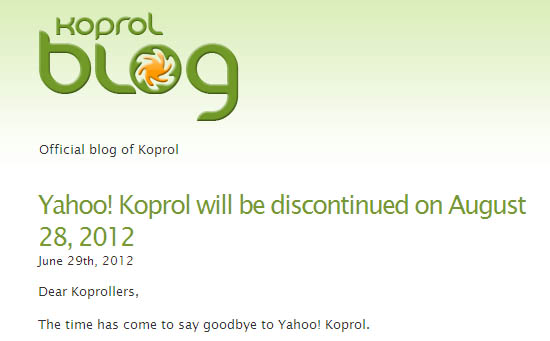
Following a round of job cuts on the team running its social networking site Koprol, Yahoo announced that it would stop the operation of the locally made geo-location site it acquired in 2010.

“Yahoo has decided to discontinue Koprol effective on Aug. 28,” the company said in a statement posted in the official website, koprolblog.com.

The company said the closure was part of to its focus to “more quickly innovate with core products and properties.”

“We are shutting down or transitioning a number of products that did not meaningfully drive revenue or engagement,” it said.

Users are advised to export their profile, including all original posts, reviews, check-ins and images, by going to 'Export Data' at m.koprol.com/export before August 28. (dmr)
Read More >>

Mind, body rest tied to concussion healing

Monday, June 11, 2012 · Posted in


Taking a week off from nearly all mental and physical activity - including television, talking on the phone and visiting with friends - was linked with improved mental performance and fewer symptoms in people who had suffered a concussion, a study said.

A week of total rest still had benefits even months after the injury, according to a report in the Journal of Pediatrics.

"That`s really important because very often we see patients with post-concussion syndrome months after their injury," said Rosemarie Moser, director of the Sports Concussion Center of New Jersey and lead author of the study.

Post-concussion syndrome involves headaches, mental fogginess, fatigue and difficulty concentrating or sleeping, among other symptoms.

Typically, rest is the main treatment, Moser said, but it`s not systematic or comprehensive and varies according to how the different practitioners define rest. The study aimed to test the results of intensive rest.

Moser`s group ordered 49 high school- and college-age patients to rest for a full week. The rescription was strict: they could not go to school or work, talk on the phone, exercise, watch TV, socialize or work at a computer.

Fourteen of the patients started the rest within a week of their injuries. Another 22 patients began resting within a month of the concussion, and 13 patients began the week of rest between one and seven months after the concussion.

At the beginning of the study, all of the patients had concussion-related symptoms, such as headaches and trouble concentrating - but all saw improvement after the week of rest.

Athletes who began the rest within a week of their concussion saw their symptoms fall from a score of 22 on a 132-point scale, to seven. Those who began their rest more than a month out saw symptoms drop from 28 to 8.

"All of those symptoms improved dramatically. Qualitatively, you feel better," Moser said.

Moser`s group also had participants take mental tests - measuring memory, processing speed and reaction time - before and after they rested, and found that patients did better on all the mental exams after the rest.

The researchers did not compare the participants` improvement to other people with concussions who got no special rest period, or who got some rest but less than the total rest that they prescribed.

"The study provides some evidence to back up a recommendation that`s already out there," said Willem Meeuwisse, a professor at the University of Calgary and a physician specializing in sports injuries who was not part of the study.

But he said it was not clear if the rest needs to be as intensive as it was in the study to provide benefits.
Read More >>

Google touts maps amid reports of Apple setback

Sunday, June 10, 2012 · Posted in


Google's digital mapping service will get several new features in hopes of becoming more convenient, comprehensive and compelling as it braces for a potential loss in traffic from Apple's hot-selling mobile devices.

Wednesday's preview of the mapping service's coming attractions seemed timed to blunt the blow from the loss of a prized perch as the built-in navigation service on Apple's iPhone and iPad. Apple Inc. intends to end its five-year partnership with Google's mobile maps next week when it will unveil its own service, according to recent reports in The Wall Street Journal and the technology blog 9to5.

Brian McClendon, a Google Inc. vice president who oversees the mapping service, wouldn't directly address reporters' questions about the possible Apple setback. "We will continue to make GoogleMaps available as widely as possible," he said.

Apple Inc. spokeswoman Trudy Muller declined comment Wednesday.

If Apple ousts Google Maps from the prominent spot on the iPhone and iPad, it would be the latest fissure between two former allies. Their relationship has been degenerating into a bitter rivalry sinceGoogle's 2008 release of Android to compete the iPhone. Since then, both companies have increasingly been encroaching on each other's turf.

Processing the mobile mapping requests from users of Apple's devices has provided Google with valuable insights into people's whereabouts and preferences. That, in turn, has helped Google sell more ads to local businesses.

None of the new features touted Wednesday by Google will be available for at least several more weeks. The upcoming options include maps that can be downloaded on mobile devices for offline access and more three-dimensional imagery — the latter coming from its own fleet of planes.

Google devoted much of Wednesday's presentation to a dissertation on all the technological wizardry that it has poured into its maps during the past seven years. The service now attracts more than 1 billion users around the world.

Without directly saying so, Google seemed to be trying to convey how difficult it will be for Apple or any other newcomer to build maps that include as many useful tools.

Besides providing 26 million miles of driving directions, Google's maps now include imagery of most of the world's neighborhoods. McClendon bragged that 75 percent of the global population can now call up a high-resolution image of their home on Google's maps, up from 37 percent six years ago.

Google also has traversed 5 million miles to take ground-level photos of communities for a feature called Street View. The company has raised privacy concerns by posting photographs that include people in unflattering situations and, at one point, including equipment that vacuumed up personal emails sent over wireless networks that weren't protected with a password.

Google plans to embellish its maps with even more photos from remote areas, such as hiking trails in the Grand Canyon, with new equipment showcased Wednesday. The photos will be taken from specially designed equipment attached to a hiker's backpack. This gear will supplement photo-snapping bicycles that Google already has been dispatching to areas that can't be easily accessed by cars.

The company also disclosed that its planes will photograph swaths of major cities to conjure more realistic three-dimensional views of metropolitan landscapes in the Google Earth version of its maps. The photos taken by the planes are automatically converted into 3-D replicas using technology thatGoogle developed for the project.

San Francisco will be one of the first cities to feature the more vivid 3-D imagery. Google didn't identify other cities on its 3-D list, but said the improvements will span communities with a combined population of about 300 million.

"We are trying to create magic here," said Peter Birch, a Google Earth product manager. "We are trying to create the illusion that you are flying over the city, almost as if you are in your own personal helicopter."

The option to download mobile maps for specific cities so they can be reviewed offline later initially will only be available on smartphones and tablet computers running on Google's Android software.

Google's maps have typically offered more tools on Android devices, including turn-by-turn directions spoken aloud. According to published reports, the bias contributed to Apple's decision to try to come up with a better alternative for its mobile platform.
Read More >>

London cabbies have ‘more fun’ with Philippine slogan

Saturday, June 9, 2012 · Posted in


Marck Acres, who drives a London cab bearing the Department of Tourism’s (DOT) “It’s More Fun in the Philippines” slogan, said the digital ad has caught the attention of some of his passengers.

"Passengers ask about it,” Acres told the Philippine Daily Inquirer in an interview at the parking lot of a London hotel on Tuesday.

Acres said the 30-second digital advertisement, peppered with faces of smiling children, has even got him interested in visiting the country "because it speaks of lots of sunshine and happy people,” he added.

Acres’ taxi was one of 50 London cabs and 25 double-decked buses fitted with the “more-fun” slogan in time for the Queen’s Jubilee celebration, London Olympics and the 2012-2013 season of the Fulham Football Club of the English Premier League.

President Benigno Aquino, who was visiting the United Kingdom, gave the campaign a boost by posing in front of one such double-decker and with some of the cabs called in for a photo shoot at the Intercontinental London Park Lane Hotel on Tuesday.

Tourism Secretary Ramon Jimenez, who was beside Mr. Aquino and other Cabinet members waving more-fun flags during the shoot, said the UK is the country’s largest Philippine market for European tourists.

Eddie Read, driver of a double-decker which also bears the DOT ad, said he had in fact visited the Philippines and tells his passengers about it.

"I tell them about how I enjoyed the karaoke and that I intend to go back there to go to Boracay,” the bus driver said.

Jimenez, in an interview at the sidelines of a Filipino community gathering Tuesday, said the President’s visit certainly boosts the tourism campaign which was timed for big events to generate more awareness of the Philippines as a top destination in Asia,” Jimenez said

Aquino, in his speech at that gathering, said he was confident that tourist arrivals (numbering about 400,000 a month since the start of the year) would be sustained. With the campaign in place, it is expected to reach 4.8 million in 12 months.

The president was also hopeful that with every tourist arrival, a job for every Filipino would also be created.

The intensive tourism campaign, Jimenez said, shows the seriousness of the government about it.

"The world will now start to see that ‘It’s more fun in the Philippines’ is not just words on a streamer,” Jimenez said.

The campaign is expected to enhance the country’s image as a top destination in Asia.

With London’s population of about 7.5 million and 1.5 million international visitors every year, “the Philippines is certainly generating awareness not only among the British population, but also among visitors to UK,” Jimenez said.

"Philippine tourism is poised to surge forward as we launch more aggressive initiatives to reinvigorate the industry and work towards achieving our 10 million target by 2016,”Jimenez said.
Read More >>

Twitter to serve up ads with 'Promoted Tweets'

Saturday, July 30, 2011 · Posted in

Twitter said Thursday that it will begin placing advertisements known as "Promoted Tweets" in the timelines of users who follow a particular brand or company.

Twitter said it will begin testing the new advertising offering with a number of companies including Dell, Gatorade, Groupon, JetBlue, LivingSocial, Microsoft, Red Bull, Starbucks and Virgin America.

Promoted Tweets from non-profits such as the Make-A-Wish Foundation and the American Red Cross will also be shown, the San Francisco-based Twitter said in a blog post.

"When we decide to follow a favorite brand, business or charitable organization, we expect to be among the first to get a special announcement, access to exclusive content or a great offer," Twitter said.

"That's why starting today, we're introducing a way to ensure that the most important tweets from the organizations you follow reach you directly," it said.

Twitter has enjoyed explosive growth since it was founded in 2006 but it is unclear how successful it has been in translating its popularity into profit.

Twitter chief executive Dick Costolo, speaking at the Fortune Brainstorm Tech conference in Aspen, Colorado, last week declined to reveal whether the privately held company is profitable.

But he said the number of advertisers on the platform is up 600 percent this year over last year, when it numbered in the hundreds.

Twitter said the new advertising scheme will involve placing "Promoted Tweets" from accounts that a user follows "at or near the top" of their timeline, or stream of messages, when a user logs in.

"These Promoted Tweets will scroll through the timeline like any other tweet, and like regular tweets, they will appear in your timeline just once," Twitter said.

"Promoted Tweets can also be easily dismissed from your timeline with a single click," Twitter added.

The advertiser-sponsored tweets will only be shown on the accounts of users of the Twitter.com website, not the scores of third-party applications used to access the service.
Read More >>

Facebook beats Google as the most commonly typed domain in the address bar

· Posted in

"Facebook.com" is by far the most common URL that people type into the address bar of their internet browser.

People are typing "facebook.com" almost three times more often than "google.com."

The URL statistics were published on July 25 by Christopher Finke, a software engineer and the creator of URL Fixer, a browser add-on that fixes human errors that are typed in the address bar on your internet browser.

Facebook.com is the most popular domain and accounts for 9 percent of all typed domains. Google.com is the second most typed address and accounts for 3.3 percent of all typed domains.

Youtube.com, gmail.com, twitter.com, mail.google.com, yahoo.com, hotmail.com, amazon.com and reddit.com also feature in the top ten most typed domains according to Finke.

According to website traffic monitoring company Alexa, the top 10 sites on the web by the amount of traffic they receive are, in order: Google, Facebook, Youtube, Yahoo, Live, Baidu, Wikipedia, Blogger, MSN and Tencent.

Finke notes in the comments on his blog that while "All of Facebook's properties (*.facebook.com) combine [to make up] 9.4% [of all typed domains]; all of Google's (*.google.com, YouTube, Blogspot, etc.) combine for at least 9.7%."

"The only locales where neither Google nor Facebook control the most popular domain are ru-RU (Russia - vkontakte.ru), fi-FI (Finland - aapeli.com, a gaming website), ko-KR (Korea - fomos.kr, an e-sports website), and zh-CN (China - baidu.com)," reveals Finke.

Not surprisingly, people often make mistakes when entering addresses into their URL bar and end up with all kinds of typos. Frequent variations on the top level domain ".com" include .com\, .ocm, .con, .cmo, .copm, .xom, ".com,", .vom, .comn, .com', ".co,", .comj, .coim, .cpm, .colm, .conm, and .coom.

"The website that appears to benefit the most from users mistyping a legitimate URL is faceboook.com (count the o's)," says Finke.

Scammers have taken advantage of the common typing error (which is typed once for every 7,930 times that facebook.com is correctly typed), setting up a website that makes visitors think they have been chosen as a "Facebook Winner."
Read More >>

Google tablets seen overtaking iPad in 5 years

· Posted in

Tablet computers running Google's Android software will catch up with Apple's iPad and surpass it in 2016, research firm Informa said.

Informa said it expects Apple's current 75 percent market share to fall to 39 percent in 2015, when Android market share will grow to 38 percent.

"From 2013, as cheaper and more advanced Android tablets enter the market, we forecast that sales will pick up considerably, eventually surpassing iPad sales in 2016," analyst David McQueen said in a statement on Wednesday.

Samsung Electronics Galaxy Tab has been the best-selling Android tablet so far, but also other vendors including Motorola Mobility use it on their devices.

"We have seen a huge explosion in the tablet market in recent years, driven primarily by the iPad, and we estimate that the market will go from strength to strength, growing from under 20 million tablets sold in 2010, to over 230 million in 2015," McQueen said.

(Reporting by Tarmo Virki; Editing by Andrew Callus)
Read More >>

First solar park due to power up

Saturday, July 9, 2011 · Posted in

First solar park due to power up
The first solar park in Wales is expected to start converting sunlight into electricity later at the Rhosygilwen estate in Pembrokeshire.

Almost 10,000 solar panels have been imported from the United States and are placed in 12 lines in a six-acre field.

The £2.5m investment will be onstream three weeks before the UK government lowers the subsidy for large-scale solar energy investors.

The site's owner Western Solar still hopes to double its size.

It is run by Dr Glen Peters who owns Rhosygilwen mansion and art centre with his family.

He said: "There are 10,000 panels here. They are very cutting edge from the States.

"They are thin film, particularly suited to our climate here of largely cloudy skies."

He has planning consent for a development twice the size but had to rethink his plans.
Continue reading the main story

"There was no bank financing available. I then had to take a total act of faith and said 'okay, we will halve the scheme, we will do one megawatt initially' and I basically raided my pension fund."

The development would be enough to power 300 homes.

Other applications for three and five megawatt solar parks at Cynheidre and Ffos Las in west Wales are said to be still in planning.

But while Rhosygilwen has beaten the government's closing of a lucrative loophole, developers like Nigel Payne of Allied Renewables in Swansea are setting their sights lower.

His company hopes to complete three much smaller, 50 kilowatt, solar parks by September.

Expansion concern


Another 10 are in the planning stage and, by reducing the size of the output, will still be able to generate a return of 30.7p per kilowatt hour.

"It spreads the feed-in tariff to what it was designed for - not supporting large-scale solar farms where subsidies would be absolutely gobbled up," he said.

The Department of Energy and Climate Change has said from 1 August tariffs would be reduced for large solar panel investors.

Any large-scale solar farms above 250 kilowatts, and up to 5 megawatts, will be able to claim 8.5p per kilowatt hour.

Schemes between 150 kilowatts and 250 kilowatts will be able to claim 15p per kilowatt hour and schemes ranging from 50 kilowatts to 150 kilowatts 19p per kilowatt hour.

Solar installations below 50 kilowatts are unchanged.

The average household installation, less than 4 kilowatts, will still be claiming the highest bracket of 43.3p per kilowatt hour.

With the solar industry increasing over the past 12 months from generating 4 megawatt of power in Britain to 96 megawatts, Dr Owen Guy, Swansea University's senior lecturer in nano technology, said there were some concerns that expansion could slow down.

"It's still available for the small-scale projects. Individuals will be able to install four kilowatt systems on their homes and will still be able to get a good return on their investment," he said.

"But the large scale companies wont be able to make the profit they have been."
Read More >>

Is Larry Page the Answer to Google's Problems?

Tuesday, July 5, 2011 · Posted in

Is Larry Page the Answer to Google's Problems?Last April, 38 year old co-founder of Google (GOOG), Larry Page, took back the reins of leading his company as CEO from Eric Schmidt. Other than a few sentences at the last earnings call, he has yet to make a public statement or speech about Google or his planned strategy.

Ten years ago, he had to give up the CEO title because his investors – some of the most prestigious venture capitalists in Silicon Valley like Kleiner Perkins and Sequoia Capital – insisted that Wall Street would not accept Page as the company’s CEO when the company planned on holding an IPO in the coming years.

Of the two Google co-founders, Page and Sergey Brin, Larry had always been drawn to leading the company. He served as CEO from the company’s founding in 1998 until 2001. He grudgingly accepted his investors’ advice and the conventional wisdom at the time that he was too young. (This was before the CEO of Facebook, Mark Zuckerberg, refused to step down as CEO.)

They chose to hire the professorial Schmidt who had last been CEO at an unsuccessful company called Novell. Page liked that Schmidt was an engineer who also had a PhD in computer engineering from University of California at Berkeley. Both drop-outs of the doctoral program in computer engineering at Stanford, Page and Brin respected people of the highest intellect. Google later created elaborate IQ tests in order to screen potential hires to the company. Schmidt passed their test.

However, deep in his heart, you can tell that Larry never really wanted to stop being CEO. In 2001, a few weeks after hiring Schmidt, Page and Brin did an extensive interview with American host Charlie Rose. At one point in the interview, Rose jokes about the recent hiring of Schmidt, asking if the two co-founders needed adult supervision. Sergey laughs it off, but you can easily read the body language of Page to grimace and look down, as if to say “I could have kept doing the job.”

Now Page has his chance. In January, Google announced on its last earnings call that Page would replace Schmidt. Although it was presented in the typical corporate fashion suggesting that Schmidt had been thinking about this for a long time, the simple truth was that Page was anxious about the state of Google and its competitive positioning in the next 5 years.

Schmidt made it clear later in interviews that Page wanted to see faster decision-making at the company. Page wants Google to be more entrepreneurial – like it was back in 2001 when he was in charge – in order to better compete against the likes of Apple (AAPL), Microsoft (MSFT), as well as the increasingly powerful Facebook.

A few years ago, the smartest kid in a college computer science class wanted to go and work for Google. Today, many want to go to Facebook. A significant number of talented Google employees have left to join Facebook in the last couple of years.

It also used to be every young private company’s dream to be bought by Google. Within the last few years, all the hottest American tech private companies – Facebook , Twitter, and Groupon – have all turned down offers to be bought by Google. This is deeply troubling for Page. Frankly, none of this has changed yet during his 3 month tenure as CEO.

Larry Page’s biggest fans within the company extol his virtues. They talk about how he is brilliant, intellectually honest, and has a vision of where the industry is going that is better than anyone else they know.

It’s clear that between Page and Brin, Page is the leader. He has the drive and desire to lead. He accepts the responsibility that comes with it and pushes his employees and the company very hard. Sergey has more of a passing interest in all the company’s actions. He would rather come and go as he pleases in terms of the day-to-day decisions at the company.

Page is most comfortable is discussing the company’s products. Google announced that it would be revamping its YouTube service to place a much greater emphasis on premium paid-for content and less on user-generated, ad-supported free content. The company launched its answer to Facebook -- Google + -- last week, which tries to leverage its search home page against the social networking gorilla. These decisions have Page’s fingerprints all over it.

Page also isn’t afraid to hurt people’s feelings and make tough decisions if it helps push the company forward. In one of his first actions, he fired former SVP of Product Management Jonathan Rosenberg. It’s clear that the role was redundant with Page’s strengths. Even though Rosenberg had previously had a high-profile public role under Schmidt, Page didn’t hesitate.

So will Larry Page be a boost for Google’s stock in the way that Steve Jobs was for Apple or will he be more like Jerry Yang running Yahoo! (YHOO)? Unfortunately, I think he’s in for more than he bargained for.

Google is a much bigger and more complex company today than it was in 2001. And, even though it is in a much stronger position today than Yahoo! was in 2007, Google needs a turnaround. That is a very different type of leadership situation than the one Page was in back in 2001. It’s like taking a pilot with a license to fly a small plane and asking him to take over flying a jumbo plan in the middle of a trans-pacific crossing. It’s a different animal.

Larry also has a great disdain for the more human and emotional aspects of being a leader. He’s much more comfortable analyzing a product or business, than giving a speech or interacting with Wall Street analysts. I suspect his first few public speeches as CEO will be disasters. And there will be intense media scrutiny of his performance, critiquing everything from the funny sound of his voice to the quality of his answers. For a technical guy like Page, I suspect it will be frustrating and he will pull back from doing more investor appearances, which will only increase investor unease with him.

Frankly, by now, I expected him to have made a couple of speeches to investors. He hasn't. That speaks volumes and doesn't bode well for him or the company's future stock price.

Remember that – prior to Google’s IPO in August 2004 – Wall Street was deeply concerned about whether the co-founders were serious enough. There was a warning in the IPO prospectus that Google’s motto was “Don’t Be Evil” and that Google wouldn’t be afraid to make strange long-term R&D investments (like in a space program, or a current initiative involving driverless cars) just to placate short-term oriented Wall Street investors. It was only after Wall Street met with Eric Schmidt that they became comfortable that the company wouldn’t do anything too crazy.

Now, with Page back in charge, prepare to see all those old fears brought back to life from many investors.

Also, one thing to keep in mind is that Page has only had 3 bosses in his life: his parents, his doctoral advisor at Stanford, and Eric Schmidt (who always deferred to him because he was a co-founder). He doesn’t know how to be a good boss from mentoring. He is going to be making it up as he goes – and most people, even really bright ones, make lots of mistakes in that kind of situation.

Larry Page does have many talented people around him, including a Rhodes Scholar, the CFO Patrick Pichette. If he listens to others' advice, he can likely succeed as Google’s CEO. But I expect a continued bumpy ride for investors in the next 6 months as he grows into the position.

[At the time of publication, Jackson had long positions in AAPL and YHOO.]
Read More >>

The apps that eat your wireless data

· Posted in

The apps that eat your wireless dataIf you have a cellphone with a monthly limit on how much data you can use, here are some tips on what types of phone use will gobble up your precious megabytes:

— Streaming video and videoconferencing. The biggest offender. One minute of YouTube-quality video eats up 2 megabytes. If you're on a plan that gives you 200 megabytes per month, you can't even watch Lady Gaga's "Telephone" video once per day. If you're on a 2 gigabyte plan you can, but don't make your iPhone a replacement for a TV. In either case, it's fine to indulge in YouTube and Netflix if you're on Wi-Fi.

— Streaming audio. The second biggest offender, and potentially more serious. While video is something we need to see to enjoy, Internet radio is more of an accompaniment to other activities, such as jogging or doing dishes. That means some people like to keep it on for hours. Audio consumes about a quarter of the data that video does, but 10 minutes a day will break the bank if you're on a 200 megabyte plan. One hour a day of Pandora consumes nearly a gigabyte, which you can afford if you're on a 2-gigabyte plan and don't use other data-hogging apps.

— Photos. If you're a real shutterbug, photos can consume significant amounts of data. Sending and viewing photos both count toward your monthly limit. Posting 10 photos per day eats up most of a 200 megabyte plan. If you're on a 2-gigabyte plan, you probably don't have to worry about photos.

— Maps. Navigation apps consume lots of data when they retrieve map images, up to a megabyte a minute. You're also likely to use them for long periods of time when you're away from Wi-Fi, such as when you're driving. Watch out for these.

— Web surfing. Web pages vary widely in size, so this will depend quite a bit on whether you like to visit graphically rich sites (lots of data) or spare, text-oriented ones (less data). But roughly speaking, ten pages a day will eat up about half of a 200 megabyte plan. Again, those on 2-gigabyte plans don't need to worry much about surfing.

— Facebook. Roughly equivalent to Web surfing. Status updates won't take much data, but sending photos and viewing friends' pictures will.

— Email. Most emails are tiny, in terms of data. Basically, you can send and receive email all you want, as long as they don't have attachments such as photos.

— Twitter. Like email, these short messages don't use much data, but if you follow a lot of people and click on links, usage adds up.

— Weather apps. Small, focused apps that report simple but useful things, such as the weather forecast, save data (and time) compared with looking up the same information on a Web page.
Read More >>

Nokia to launch Microsoft platform phones in 2011

Friday, July 1, 2011 · Posted in

Nokia to launch Microsoft platform phones in 2011Finnish handset maker Nokia Corp. says it plans to introduce this year its first mobile phone using the Microsoft Windows platform.

Chief Executive Stephen Elop said in a speech Tuesday in Singapore that Nokia will start to deliver the models in bulk during 2012.

Nokia also unveiled its N9 smartphone model, which is based on the MeeGo platform. Elop said the N9 would be launched later this year, but declined to specify the date or price.

Nokia is facing steep competition at the top end of the market against smartphones such as Apple Inc.'s iPhone, Research in Motion's Blackberry as well as Android, and on the lower end against emerging market phone makers who are dropping their prices on devices.
Read More >>

Google unveils latest social networking feat

· Posted in

Google unveils latest social networking featOnline search leader Google Inc. is taking yet another stab at social networking, as it tries to go up against Facebook in this wildly popular and lucrative segment of the Internet. This time the project is called Google+ and it aims to make online sharing more like real life.

"We think people communicate in very rich ways," said Vic Gundotra, senior vice president of engineering at Google. "The online tools we have to choose from give us very rigid services."

Other social networking tools make selective sharing within small groups difficult. They don't allow or the nuances that people are used to in offline communication and because they call so many acquaintances "friends," said Gundotra in a blog post announcing the service.

Many Facebook users, for instance, find it difficult to limit their status updates to small groups of people so that their coworkersaren't exposed to party photos or their parents aren't privy to flirtatious posts on their "wall." Though Facebook has tried to address this with a much-hyped "Groups" feature, it's not clear how many people use it.

Gundotra's criticism seems aimed squarely at Facebook, the world's largest online socia network. Facebook has become synonymous with online sharing since its founding seven years ago.

In a prepared statement, Facebook said only that "we're in the early days of making the web more social, and there are opportunities for innovation everywhere."

Google, which dominates Internet search wit a firm hold on two-thirds of the U.S. market, has been experimenting with different social tools since late 2009 with limited success. "Buzz" was one major mishap. The product was a social network attached to Google's popular Gmail service, and it wound up exposing email contacts that users did not want to share. Google eventually agreed to submit to independent audits of its privacy controls every other year for the next two decades as part of a Federal Trade Commission settlement.

Google shut down another attempt at online sharing, Google Wave, last August after unveiling it with much fanfare in 2009. The service, which let users chat, share files and collaborate on documents in real time, didn't gain enough fans.

More than a year in the works, the project Google unveiled Tuesday lets users share things with smaller groups of people through a feature called "Circles." This means only college buddies, say, or your favorite co-workers can see the photos, links our updates that you post.

Another feature called "Sparks" aims to make it easier to find online content you care about, be it news about surfing or barbecue recipes. You can then share this with friends who might be interested in it. In an online video, Google calls it "nerding out" and exploring a subject together.

There's also a group messaging service called "Huddle" and a feature that lets users instantly upload photos that they take with mobile phones. The photos are stored in a private photo album on Google's remote servers, and users can access them and share them as they see fit.

Altimeter Group analyst Charlene Li has high hopes for the friend grouping feature. She said that her biggest pet peeve with Facebook is its existing friend management tools. She noted that millions of people already use Google to share things with others via email, and Google+ looks like a natural extension of this type of sharing, making it more functional and organized.

"I think Facebook is going to have to up its game," she said.

Google+ is undergoing what the company calls a "field trial," so it's accessible by invitation only and not yet available to the public. The company declined to say when it'll be more widely available.

Lou Kerner, a social media analyst with Wedbush Securities, believes the game is over in the competition to become the world's global social network. With 700 million users, Facebook has won, he said.

There's a lot more to the social Web than just creating a successful social network, though, and Kerner thinks that with Google+ the search leader is trying to make its existing product offerings more social.

"I don't think they're seeing this as a direct competitor to Facebook," he said.

Google+ does have its skeptics.

"People have their social circles on Facebook," said Debra Aho Williamson, principal analyst with research firm eMarketer. "Asking them to create another social circle is challenging."

And Google is still best known for its flagship service, online search.

"The whole idea of a Google social network...they've been throwing stuff against the wall for several years and so forth nothing has stuck." Going to Google to be social, she added, is like "going to Starbucks for the muffins. Or, for that matter, going to Facebook for search."
Read More >>

Popular Posts

Powered by Blogger.